Typhus arrives in Moreton Bay
 |
| Idealised view of a German emigrant ship |
 |
| Cheery scene below decks |
In early January 1873, a German emigrant ship arrived in Moreton Bay after a voyage lasting three months. The Lammershagen had sailed directly from Hamburg with some 380 souls on board.
Rather than transferring the weary passengers to a steamer to carry them up-river to Brisbane Town, other procedures were put into action.
After a visit from the medical officer from Brisbane, the boat was immediately put into quarantine and towed to Peel Island.
THE German immigrant ship Lammershagen, which arrived from Hamburg on Tuesday, has, we regret to say, been placed in quarantine, owing to the fact of there being typhus fever on board. At the present time there are several cases amongst the passengers, one of which is looked upon as hopeless. During the passage, eight deaths occurred; but these were from various causes, typhus fever having, we understand, only broken out during the last two or three weeks.[1]
 |
| The scene below decks on a crowded emigrant ship |
This last statement was not quite correct. It would later become known that the first case had occurred less than one month into the voyage. This confusion of information would continue as the story of the Lammershagen emerged over the following weeks. The tales of the conditions on board and the conduct of the ship’s doctor varied wildly and culminated in a Government enquiry.
It emerged that the Lammershagen was not only overcrowded, unhygienic, and poorly ventilated but severely under-provisioned. – ideal conditions for an outbreak of typhus, commonly known as “ship’s fever”.
 |
| Moreton Bay and Stradbroke Island |
The steamer Kate, on her arrival from Ipswich on the 8th, was despatched to the Bay with every requisite obtainable for making the passengers as comfortable as possible under the circumstances. The intention is to tow the vessel to Peel Island, when the immigrants will be landed, and provided with tents; a temporary wooden hospital being erected for the use of the patients, who will be separated as far as possible from the remainder of the passengers.[2]
Because the number of quarantine cases up to this time had greatly declined, the quarantine station at Dunwich on Stradbroke Island had been appropriated as a Benevolent Asylum. The facilities on nearby Peel Island were woefully inadequate to receive the 350 odd passengers from the Lammershagen. Some of the spare sails had to be taken ashore to provide further shelter.
Peel Island (in Moreton Bay) was selected, and off that the ship was moored, the passengers being landed and "housed" - if the term be permissible - under tents, or whatever other shelter they could get, the season, moreover, being exceptionally wet. The latest reports from Peel Island are of a favourable character, but there is no knowing how long the unfortunate "suspects" may stay where they are - the victims of discomfort, and ignorant, probably, of the regulations which compel their detention.
If report does not egregiously err, the new arrivals by this vessel have had anything but a cheerful introduction to their new home. No doubt the Government have done the best they could under the circumstances, but, to say the least of it, it was unfortunate that the first experience of Queensland gained by these people should be to "camp out" on an island in drenching rain, huddled together like sheep in an ovile[3].[4]
 |
| Peel Island, the QuarantineStation was in the north-western corner |
While the immigrants remained in quarantine, possible reasons for the Typhus outbreak were discussed in the press. Typhus, spread by lice, was known to appear in crowded, unsanitary, and poorly ventilated conditions - it was common in the crammed English prisons in the 18th century. Typhoid fever, a different ailment, is contracted from contaminated water. A correspondent to the Brisbane Courier pointed out these facts.
Typhoid fever, developed as it has been in this ship, is not what is sometimes called, "a visitation of GOD". There is no room for any such impious imputation. If it is a visitation at all, it is a visitation from some festering impurities generated by defective ventilation, or over-crowded and unclean quarters. It is an effect which we have no doubt can be clearly traced to an efficient cause, and there will be no excuse if those to whom that cause can be traced are not held responsible for its existence. The legal pains and penalties which it may be possible to inflict are slight in comparison with the injury inflicted, but the blame should be impartially adjudged, and those who deserve it should be made, as far as possible, to feel their culpability.[5]
There was clearly a failure of the shipping company to ensure the passengers had sufficient space and ventilation and provisions. During the voyage it was responsibility of the ship’s medical officer to maintain proper standards of hygiene during the voyage. One correspondent to the Courier Mail blamed the Scandinavians amongst the passengers.
The majority of the immigrants are Scandinavians, hailing from Norway and Sweden and it was amongst them that the sickness first made its appearance on board.
Tho Scandinavians, it is also stated, came on board very scantily clothed, and the blankets supplied by the contractor at Hamburgh for their use were miserable rags. The races of Northern Europe are not noted for their cleanliness of living, and it was no doubt impossible to compel such a number of half clad people as these appeared to be, to preserve those habits of personal cleanliness which are strictly necessary to the carrying out of proper sanitary regulations on board a crowded immigrant ship.[6]
Later it became known that the sister ship of the Lammershagen, the Alardus, had experienced a similar epidemic and only made it as far as Melbourne. Finally the colonial authorities sent a complaint to London requesting that the Hamburg shipping company involved be advised to send no further emigrants to Queensland.
Mr. Palmer has telegraphed to Mr. Daintree, the Agent-General in London, complaining of the condition of the German immigrants per "Lammershagen," on their arrival at Brisbane. Mr. Palmer also comments on the state of the immigrants of the "Alardus," which has had to put into Melbourne on account of the mortality and sickness on board. He gravely censures those connected with the shipment of the immigrants by both vessels, and instructs the Agent-General not to allow in future German emigrants to Queensland to be forwarded by the same medium.[7]
 |
| Emigrants awaiting Embarkation in Hamburg |
As the Lammershagen immigrants were slowly released in small groups from quarantine, accounts of their experiences both while on Peel Island and on the voyage were reported in the colonial press. A correspondent for the Queenslander had heard nothing at all negative from Peel Island.
The Lammershagen people are nearly all cleared out now. A batch, consisting of six married couples, eleven single girls, nine single men, nine children and two infants will be sent up to Brisbane tomorrow or Tuesday, and then there will only be nineteen adults left. There have been no signs of fever among them for some time past, and all the people at the station are in good health. Dr. Schmidt seems to have performed his arduous duties in a most satisfactory manner, and all the passengers speak in high terms of his skill, attention, and judicious management.[8]
Soon other reports of Dr. Schmidt’s behaviour emerged in which many of the passengers did not “speak in high terms” of the supposedly heroic Doctor. Charles Campen, an influential member of the Brisbane German community took up their case with the Colonial Secretary. As a result an official enquiry was held. In the meantime Dr. Schmidt had been permitted to leave the colony.
The first witness examined was Charles Campen, who deposed that he forwarded two letters of complaint, one to the Immigration Agent, dated April 21, 1873, and tho other to the Colonial secretary, dated April 28, in reference to the treatment of immigrants by the Lammershagen whilst in quarantine; the first complaint made in the letter against the doctor was for having exposed a woman for two hours in the sun under a tree or something erected like a gallows on Peel Island, Wilhelm Frederick and his wife, the persons mentioned in the letter, were in attendance to substantiate the charge, but unfortunately most of the other persons were scattered over the colony.[9]
 |
| Medieval "Pranger" or Pillory, Bonn |
The incident of the “gallows tree” was the result of a letter received by Dr. Schmidt, allegedly written by Emelie Roeder, the wife of Wilhelm Frederick. The writer accused the doctor of having a more than working relationship with the matron. A correspondent who was a passenger aboard the Lammershagen explained the “Pranger” ritual.
He took it upon himself to erect on Peel Island a kind of gallows, threatening to hang everybody who would not obey his orders. He made use of the latter tree for inflicting a peculiar and degrading punishment, called in Germany the "Pranger," which is considered in Germany the most disgraceful punishment to any person, particularly to a woman, inasmuch as a person of that sex must be of the worst and lowest character to be thus punished.[10]
Despite the evidence presented, the Enquiry completely exonerated Dr. Schmidt, dismissing the charges as “frivolous in the extreme”.[11] Despite claims of a whitewash by the Immigration Board, no further action was taken. Evidently the Board did not wish to discourage further immigrants by giving credence to the complaints of the Lammershagen passengers.
Perhaps the most credible account of the doctor's behaviour was given after the enquiry finished, by a passenger in a letter to the Queenslander. The standard of English used suggests the correspondent may have had some editorial help from the German immigrant’s advocate, Mr. Campen.
As a passenger by that vessel, and a constable on board, I had sufficient opportunity to see what was going on, and it is a fact that this late surgeon-superintendent of the Lammershagen, Dr. Schmidt, made himself extremely unpopular with all the immigrants on board, so much so that a regular mutiny was very nearly breaking out against him.
This unpopularity of his arose chiefly from his utter want of proper feeling in the treatment and management of young children, the truth of which may easily be understood from the fact that amongst seventeen children born on board the larger portion died. The following facts, however, which I am capable of substantiating, will show what the doctor's conduct really was:—
1. Dr. S. has been guilty of improper behaviour with the matron, and has repeatedly sung indecent street songs in the presence of the passengers.
2. He has beaten several women—vis., Auguste Moderow, Anna Moderow, Paulina Boehm, and Anna Olsen.
3. He has habitually used insulting language towards the passengers, such as calling them a "gang of thieves," "tag-rag," &c.
4. He took it upon himself to erect on Peel Island a kind of gallows, threatening to hang everybody who would not obey his orders.
I may add here that in the beginning of February a number of immigrants, then just arrived at the depot, drew up a petition, signed, and left it in the Immigration-office for Mr. Gray, saying that they had complaints against the doctor, and that they demanded enquiry. Nothing, however, has been since heard of that petition.
Had Mr. Gray taken any notice of it at the time it was lodged with him, that is, when the complaining as well as the accused parties were still to be brought face to face, it is highly probable that the results of such an enquiry would have been quite different from those obtained from the enquiry which took place last week after the doctor and the principal complainants were out of reach.[12]
 |
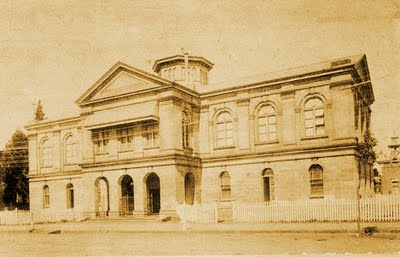
| Town Hall Queen St. Brisbane ca. 1868 |
Finally in June 1873, the German and Scandinavian residents were called to a meeting.
ON Thursday, May 29, a meeting of our German and Scandinavian fellow-colonists was held in the Town Hall, and largely attended. Mr. H. Ruthning opened the proceedings by reviewing the action taken by the local authorities, in the case of the Lammershagen, and pointed out that unless the colony was sure every precaution was taken to give to the German and Scandinavian immigrants on their passage out suitable ships, with sufficient room and good ventilation, the Germans and Scandinavians should be the first to demand a stoppage of continental emigration.[13]
Postscripts
A report published in 1876, described the ovens made by the Lammershagen passengers while on Peel Island.
The immigrants by the Lammershagen did manage to excavate little caves in the face of the cliff, which they converted into little ovens and baked excellent bread therein, but those have all fallen into decay now.[14]
 |
| Cabins constructed for leprosy patients on Peel Island |
In the early 20th century the quarantine station was converted into a Lazarette to treat leprosy patients.
n 1882, the Lammershagen met her end when she was wrecked on a rocky point on the coast of Wales. A contemporary painting recorded the event.[15]
 |
| The Wreck of the Lammershagen, 1882 |
Five years after the Lammershagen incident, Charles Campen met his end after getting into severe financial difficulties.
IT was currently reported in town yesterday that Charles Gerhard Campen, a man well-known in the community, had committed suicide by drowning. There is a considerable amount of mystery surrounding the affair, but we learn on good authority that serious pecuniary difficulties gave rise to Mr. Campen's forwarding to a prominent citizen a statement of his monetary affairs with an intimation that he intended to commit suicide to avoid exposure. The following letter was addressed to the Police Magistrate:-
"If I went home [meaning Germany] all would have been well; it is too late now. I dare not wait any longer because I feel my reason is going to give way. Mr. Macpherson has my last statement showing how I got into difficulties. There is no need of a post-mortem examination. I die of my own free will. The Lord have mercy on my poor children.”[16]
His body was found four days later floating in the Brisbane River under the Albert Bridge at Indooroopilly.
 |
| Peel Island Cemetery ca. 2000 |
[1] The Brisbane Courier 10 January 1873
[2] The Queenslander 11 January 1873
[3] Enclosure for sheep.
[4] The Sydney Morning Herald 25 February 1873
[5] The Brisbane Courier 13 February 1873
[6] The Brisbane Courier 22 January 1873
[7] Rockhampton Bulletin 24 April 1873
[8] The Queenslander 15 March 1873
[9] The Brisbane Courier 14 May 1873
[10] The Queenslander 17 May 1873
[11] The Brisbane Courier 14 May 1873
[12] The Queenslander 17 May 1873
[13] The Queenslander 7 June 1873
[14] Ludlow, Peter, Peel Island – Paradise or Prison?, 1987.
[15] Collection MS, P.W.J. Chadwick, John Oxley Library, State Library of Queensland.
[16] The Brisbane Courier Friday 15 February 1878
©
K. C. Sbeghen, 2012.